
It was really bad.
An epidemic had hit. Everywhere it seemed like people were dying. The population was terrified. They were desperate to find a solution.
And then politics got in the way.
Instead of the leaders coming together to work to find the best solutions available based on the best knowledge available, politics drove the leaders to become obstinate. People became definite in their opinions and argued from one of two extremes. And instead of working to find the best solutions each side just argued ever more strongly about how they were right and the other side was wrong.
Sound familiar? But I am not referring to the COVID 19 pandemic, or the more current health issue related debates. This was 1793 and the problem was yellow fever.
In a few short months, one out of every 10 persons in the city of Philadelphia was dead from yellow fever.
We now know a lot about yellow fever:
- Yellow fever is caused by a virus that is transmitted from person to person by mosquitos. About 15% who get it will develop severe disease. In those persons 50% will die.
- The best short-term fix in 1793 (if they had known):
- Reduce mosquito exposure. Get away from wet areas. Use mosquito netting. Give supportive care with fluids and rest for people who are ill and shield them from mosquitos that can spread the disease to others.
- In the 1930s an effective vaccine was developed. A single shot provides lifelong protection.
But they did not know that in 1793. They understood so little about what was going on. Their therapies made no sense – and actually – caused great harm.
I wonder what I would do if I were able to go back in time to try to help them. How would I get them to listen to me? When I think about what the medical leaders did, I cringe: Bleeding and purging.
The brightest and most respected doctor in Philadelphia at the time was Benjamin Rush. Medical theory at that time was based on Galen’s theory. This stated that illnesses came due to an imbalance in the humors. The human body was thought to be made of four humors:
- Blood
- Phlegm
- Yellow bile
- Black bile (also called melancholy)

According to Galen, disease is caused by an imbalance in these humors. Doctors would then use emetics (medicines to cause vomiting), laxatives and bloodletting to shift the balance of the humors and restore health. When persons became sick with the yellow fever, Dr. Rush and the other physicians would be called. They would then administer noxious substances to make the patient vomit and develop diarrhea. They would give large doses of mercury. They would also cut them to drain them of blood.
Some of his patients recovered.
From our vantage point now, we can realize that these patients would have recovered without him. Indeed they recovered in spite of him. But Dr. Rush and his colleagues didn’t know that. They embraced these “anecdotes” of the patients who recovered. They reinforced their belief that they were doing good.
Alexander Hamilton entered the scene.
Dr. Rush and Hamilton were already political opponents. It seems that Hamilton had a way of rubbing people the wrong way. Hamilton, however, had grown up in the Caribbean where yellow fever was a big problem. In the Caribbean, the population had abandoned the practices of purging and bleeding. The treatments instead focused on rest, supportive care and time.
Hamilton felt that Dr Rush was wrong and advocated for the “French” or “West Indies” cure. He and others told the patients and families to stop the purging and bleeding. What they needed was fresh air, hydration and time, not the loss of fluids and blood that were weakening them.
This was an insult to Dr. Rush and his colleagues.

Debate ensued in the city. Dr. Rush had observed that a large number of his patients died with his treatments. But he also remembered the ones who survived. What was he missing if some were “cured” and some not? He decided that the problem was not that his treatments were wrong, but that he was not pushing hard enough. He intensified his efforts and did even more extensive purging and bleeding.
Double down[1] (intransitive verb): to double the original bid in blackjack in exchange for only one more card
Often a poker player when he is extended out very far on his bet will double down hoping to rescue his position. There is a tendency in politics to “double down”. Rather than an introspective look to think that you might be wrong, politicians often instead argue their point even more vigorously.
In science the opposite is demanded. Scientists must hold their theories lightly. Truth matters more than whether their current theory is correct. If the data contradicts their theory, they must sacrifice their theory or modify it. They must do this even though their theory might be prized by them and even something they had staked their name on.
Dr. Rush’s patients were dying. The treatment advocated by Hamilton was seeming to help. What did he do? It was before the scientific method was embraced by medicine (this did not enter medicine until the late 1800s)[2]. And politics had gotten involved.
Dr. Rush doubled down.
I remember my first day in residency when I came back from the Navy. My first rotation was in the ICU and there were a lot of very ill patients. One patient “crashed” in front of us. We rapidly put him on life support and then proceeded to do a number of procedures to “save his life.” It was very exciting.
Then one day, I learned a profound lesson. It came from one of the most experienced intensive care physicians. I can still picture the scene. He was standing in the doorway of a very ill patient’s room. He was not acting. He was thinking. He said to me, “Don’t just do something. Stand there!”
His twist on the usual statement went against my instincts. It seemed so ironic but within it was profound wisdom. When we see a crisis, we all feel driven to act. We want to rush in and be the hero. What he was teaching me was that in medicine we commonly can do as much harm as good.
Benjamin Rush was an amazing man worthy of our respect. He meant well and he put his own life at risk and pushed himself to exhaustion in his efforts to “save” his city. He was, however, sincerely and profoundly wrong. In his efforts to act he caused harm. The city would have been better off without him. Furthermore he allowed himself to become influenced by his politics and his bias. He fed off of his “successes” = the patients he treated who survived and got better. We call stories about individual patients, “anecdotes.” Dr. Rush had accumulated anecdotes which drove him to ignore the evidence that contradicted his claim.
Philadelphia in August 1873, would have been better if he had said, “Don’t just do something. Stand there!”
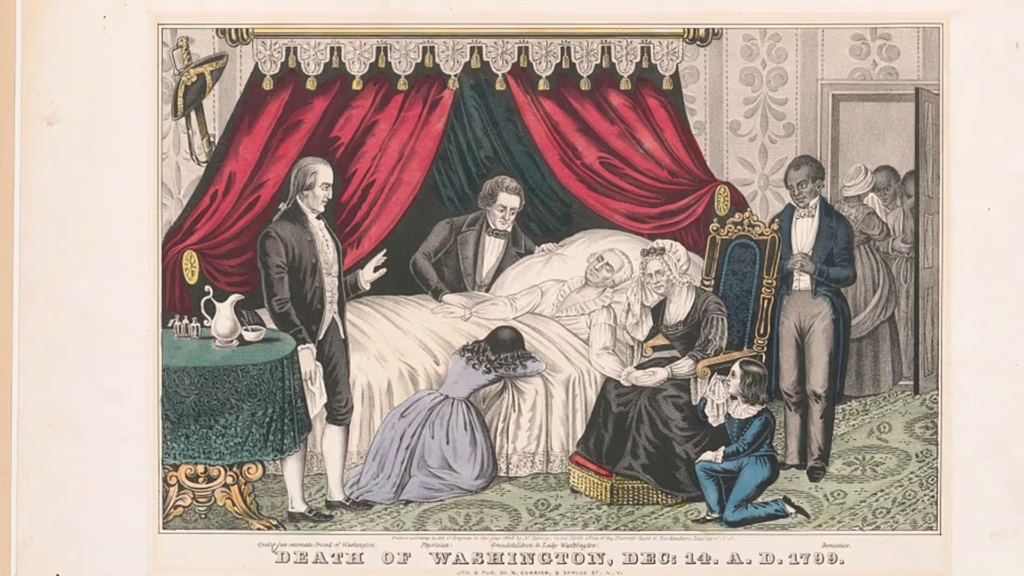
George Washington was dying. On December 12, 1799 he kept to his routine and rode his horse around Mount Vernon despite the cold weather and a heavy snow. He became ill with a respiratory infection afterwards. His illness progressed quickly and by December 14 he was in trouble. His throat was swollen and he was struggling to breath.
What could they do?
Washington believed in bloodletting. He had seen others recover from illness after bloodletting. He had his workers drain some of his blood. When he worsened further, they called his physician. Dr. James Craik arrived and applied a preparation of dried beetles to blister his throat and then bled him more.
But this was George Washington.
Dr. Craik needed to be extra careful. He sent for more help. He requested that Dr. Gustavus Brown be sent for. He worried that Dr. Brown would not arrive in time and so he also asked that Dr. Elisha Cullen Dick be sent for (one of my ancestors!) Both doctors arrived and all 3 consulted together. Drs Craik and Brown felt that he had quinsy[3] and they advocated for further purging and bleeding. Dr. Dick felt that he had epiglottitis which is a critical and often fatal inflammation of the throat. He advised that Washington’s only hope was to undergo an emergency tracheotomy and that they needed to stop bleeding and purging him to preserve his strength.
Dr. Dick was however younger than the other two physicians. The other two rejected his advice. Tracheostomy was new and they would not venture to try something new on such a prominent patient. They fell back to their usual strategy. They drained him of even more blood. The historians estimate that over the course of that day, Washington had been drained of more than 5 pints of blood (40% of his total blood volume). Shortly thereafter he died.
Dr. Craik and Dr. Brown’s analysis: They did their best. Despite their best efforts he died. At least his death wasn’t for a lack of treatment. People die, even famous persons. His disease was so severe that he died even with the best treatment.[4]
What would have happened if they had listened to Dr. Dick? What would have happened if they had not treated him at all? There is a chance that he might have survived without the doctors and the treatments they subjected him to that weakened him so much. There would have been a greater chance if they had allowed Dr. Dick to do the tracheostomy.
They were sincerely wrong.
What can we learn from all of this? There are several very important concepts:
- Fear and need can drive error and harm.
- We need to acknowledge that it is a broken world. Our knowledge and capabilities lag behind our needs. We all lose loved ones. Many endure chronic debilitation. It is tempting to offer “cures” based on speculation and stories of others. We cannot just by force of will or extremity of need come up with the correct answers. We still do not have enough knowledge. Our knowledge in this fallen world will continue to lag behind our need. Bad things happen and it is overly optimistic and naive to think we are going to explain all of them.
- Anecdotes drive theories but do not prove the effectiveness or safety of treatments. We need anecdotes as we struggle to learn and discover. In those stories and experiences we may find hints at truths that can help us. But we must be careful because many persons get better in spite of the treatments rather than because of them. Medicine is full of examples of therapies that seemed to work but in the end were proven to be ineffective (at best) or often even harmful. Anecdotes can be quite dangerous. Much harm is done when people grab onto anecdotes assuming that “association proves causation.”[5] This thinking aborts the process to find truth. It can deprive patients of other effective treatments or expose them to side effects from unproven and ineffective treatments.
- The scientific method is our primary way to sort out what is truth.
- Hypothesis = A guess based on hints and concepts. For example, a specific treatment will improve survival for a condition. Anecdotes can drive hypothesis formation.
- Test = A carefully designed test. In medicine this is a double blind randomized placebo controlled trial so that all bias is excluded.
- Analyze = Objectively review the data from the tests. Did the results prove or disprove the hypothesis?Abandon or revise the hypothesis based on the results of the test.
- Start over.
- Politics frequently causes more harm than good in science. Let’s be clear: The process of politics is quite different from the process of scientific investigation. The process of politics is that of debate and argument. It encourages adoption of bias to be able to more effectively argue your point.
- The goal of politics is to win people over to your views and your argument.
- Science instead embraces self-criticism of your hypothesis and constant questioning about whether or not you could be wrong.
- Politics cannot tolerate this degree of weakness where “only the strong survive.”
And so I become distressed as I read the news each day.
If you could get in a time machine and travel back to 1793 Philadelphia or 1799 Mount Vernon, what would you tell them? If someone could travel back from 2125, what would they think of what we are doing now? And how are we going to get the truth? How are we going to find the answers to the problems that plaque us today?
It isn’t going to come through politics, polarized debates, or your opinions no matter how strongly you hold them and no matter how sincere you are.
It also isn’t going to come as quickly as you want. I am sorry but we’re still victims of the knowledge gap today just as our ancestors were in the 1700s. We have many wonderful cures, but we do still suffer and die.
Force-of-will alone cannot drive answers. Just because you “must” have an answer doesn’t mean you will find one. Dr. Rush was determined. He “had” to find answers. People were dying in his arms every single day. The knowledge was just not there. Sometimes you cannot just declare that you are going to solve this and then do so.
We must continue to use the scientific method. We must reject what is not proven and objectively accept what has been proven. We have to ignore what persons of bias want to thrust into the discussion or how politics skews data away from truth. We have to continue to seek truth and humbly acknowledge that all of us are likely at least partially wrong.
This is not a pessimistic endeavor, however.
In my own field of heart failure, I see success stories every single day. I tell my patients that I do what I do because of the privilege of being able to guide them to effective therapies. I cherish the amazing persons of science who led the way to these discoveries. Please understand, that because of science how I practice today is different than what I did at the beginning of my career. Science serves me well as we all constantly question, look and investigate how to best help our patients.
How do we know what is true then?
Take heart. This is a question that all of us spend our careers teasing out. We have huge infrastructures in place to work through this including peer reviewed literature and international society consensus documents and guidelines. We meet together regularly as experts. We debate and argue and scrutinize data. Truth is king and we pursue it aggressively. It may not move as quickly as any of us would like but it does work.
Are we just supposed to blindly accept what we are told? No.
A questioning attitude is a key part of finding real truth. But be careful in what you read and believe.
There is now an entire industry focused around getting “clicks” and garnering public opinion. The more sensational something is, the more profitable it is. Sadly, grabbing your attention and getting your click is often more important than the truth.
Dr. Rush meant well. He had no idea what was really going on and the impacts of his treatment. He was wrong. Fear and dogma drove action that caused harm. I suppose if that happened today we would have competing podcasts touting Rush vs Hamilton based approaches. But understand that while such ventures may get your attention they generally don’t get us closer to the truth.
Be careful in what you read. There is a rigor to reviewing scientific articles to not jump to false conclusions. Peer review also is designed to reduce bias and error from publication. Sometimes it misses. In recent years there has been a dramatic increase in articles which upon post-publication review were found to be fraudulent and were later withdrawn. Unfortunately many of these often still circulate on the internet. Some of these are cited by podcasters to support their views in spite of the articles having been debunked.
What do you do?
Know that there are vast numbers of us who have committed our careers to discovering and applying scientific truth. Within our respective fields we review and debate and review again the available science in a relentless search for the truth.
Seek out experts. These experts should be well embedded in a robust scientific process. I belong to multiple different organizations (ACC, HFSA, ISHLT) at significant personal expense each year. I do this as an obligation to my patients and as a commitment to the truth.
Beware the extreme or sensational. They may be just seeking fame or finance. They might also be sincerely wrong.
Go ahead and get a 2nd or even a 3rd opinion if you need to. Personally I love it when patients do this because if I am wrong I will take any help I can get to find that out.
And please know that most of us who are physicians went into healthcare to help. We really do honestly want to help you and your loved ones get better. I don’t know as much as I need to. But I am, like most in healthcare, willing to try to do our best to navigate these things with you.
[1] https://www.merriam-webster.com/dictionary/double%20down
[2] https://pubmed.ncbi.nlm.nih.gov/10487407/ – Johns Hopkins was established in 1876 and was one of the first centers to embrace the scientific method and apply it to medicine.
[3] Quinsy was the term for a peritonsillar abcess. This is in of itself a serious condition that we would now treat with antibiotics and surgical drainage. But in 1793 they did not understand about infections. They thought the only control they had was to “rebalance the humors.”
[4] In a letter to Dr. Craik on 2 Jan. 1800, Dr. Brown was high in his praise of Dr. Dick, and wrote: “You must remember he was averse to bleeding the General, and I have often thought that if we had acted according to his suggestion when he said, ‘he needs all his strength—bleeding will diminish it,’ and taken no more blood from him, our good friend might have been alive now” (quoted in a note in Ford, Writings of Washington, 14:257). https://founders.archives.gov/documents/Washington/06-04-02-0406-0001#GEWN-06-04-02-0406-0002-fn-0006-ptr
[5] Does ice cream cause drowning? One study showed that an increase in ice cream sales was associated with an increase in drownings. More thorough study however then showed that both were related to atmospheric temperature. In other words, when it is hot outside, more people eat ice cream and more people go swimming. If more people go swimming there are going to be more drownings. There is no data that eating ice cream causes drowning. https://www.techno-science.net/en/news/more-ice-cream-sold-more-drownings-why-N27193.html An additional example during COVID showed the persons who watched one television show had a higher death rate than persons who watched a different television show. Would we conclude that television shows can cause death? Or is there a different explanation for the observation?


2 replies on “Science, Politics and Disease”
Thanks Mike, well said. I appreciate your perspective. Les
Thankful that your goals are to help the patient and to always seek the truth.